Forward Future Tools Library

Basic.ai logo

Basic.ai

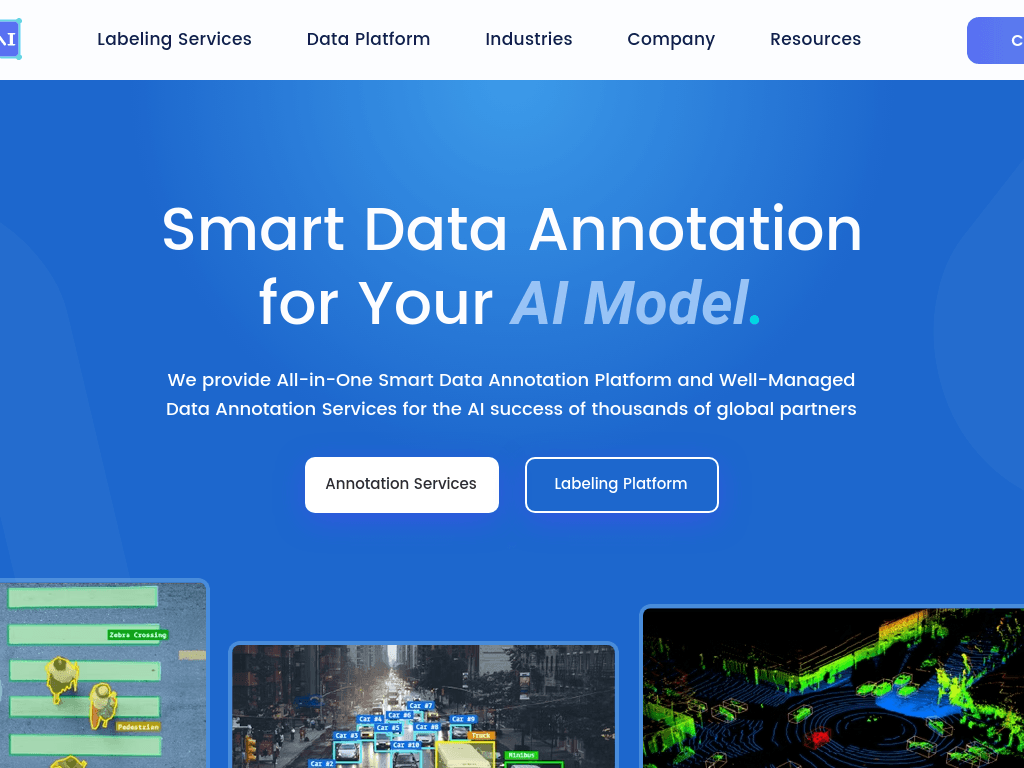
BasicAI combines annotation software and managed labeling services for machine learning teams building computer vision, NLP, 3D, audio, video, or RLHF datasets.

Try Basic.ai

basic.ai·From $6,600/y·Checked 2026-08-12

Basic.ai screenshotMy 7 Best AI Tools for UI DesignTop AI UI Generator: For a faster UI Design in 2026Best AI for UI Design in 2026: Free & Paid OptionsAI-Powered UX/UI: Top 12 Tools Used by Leading Web Agencies
Basic.aibasic.ai
Basic.ai screenshot
Basic.aibasic.ai

What is Basic.ai?

BasicAI provides a data annotation platform and managed labeling services for AI training data. Its tools cover images, video, audio, text, 3D point clouds, sensor fusion, and 4D radar. Teams can use AI-assisted annotation, customizable workflows, batch quality checks, and private or on-premise deployment.

What are the pros and cons of Basic.ai?

Strengths

Combines self-service annotation software with managed labeling services
Supports a broad range of data types, including 3D LiDAR, images, audio, video, text, and 4D radar
Offers private-cloud and on-premise deployment for direct data-processing control
Uses multi-level inspections and validations, with the website stating 99%+ quality assurance
Provides specialist annotation teams rather than relying on crowdsourcing

Trade-offs

Pricing is not fully transparent and requires sales involvement for customization and payment terms
Private-cloud deployment starts at $6,600/y, which may be unsuitable for small projects
Specialized enterprise annotation services may take longer because of their quality-focused delivery process
Documentation is sparse in some areas and the integrations list is still growing

What are Basic.ai’s key features?

AI-assisted annotation for images, point clouds, and audio
Bounding box, object tracking, semantic segmentation, and 3D point cloud tools
Text annotation for NLP, RLHF, and SFT dataset creation
Customizable workflows with task tracking, role management, and performance reporting
Real-time feedback and configurable batch QA rules
Private-cloud and on-premise deployment options
Managed annotation services using specialist teams

What are the best use cases for Basic.ai?

Labeling 3D LiDAR and point cloud data for autonomous vehicle, GIS, or robotics models
Creating bounding box and semantic segmentation datasets for computer vision
Annotating text for NLP and large language model training
Tagging audio and video for machine learning projects
Building RLHF and SFT datasets with human preference labels
Running multi-annotator workflows with quality inspection and targeted human review

What is the pricing for Basic.ai?

PlanPriceDetails
Private-Cloud Deployment$6,600/yIncludes teamwork features, image, video, text, audio, 3D sensor fusion, and 4D radar tools, with customizable seats, storage, model calls, QA rules, and data conversions.

Payment cycle, seats, storage, and model calls are customizable. On-premise deployment options are available. Contact sales for the company plan.

Checked 2026-08-12 · source

Who is Basic.ai best for?

enterprisePrivate deployment, role controls, scalable workflows, and managed specialist teams suit enterprise AI data programs.
machine learning engineersUseful for building computer vision, NLP, 3D, video, and RLHF training datasets with integrated QA workflows.
autonomous vehicle developersThe 3D LiDAR, point cloud, sensor fusion, video, and 4D radar tools address autonomous-driving annotation projects.
Not for
  • Solo users or small projects seeking a low-cost self-service tool, because the listed private-cloud plan starts at $6,600/y.
  • Teams that require a mature, extensive integrations catalog and comprehensive documentation.

What are the best Basic.ai alternatives?

Where can I try Basic.ai?

Open basic.ai