

Forward Future Tools Library

JudgeAI
JudgeAI models rules, relationships, possible actions, and consequences to produce traceable regulatory decisions for legal, public-sector, and AI governance teams.
Try JudgeAI →
judgeai.space·Contact Sales

›What is JudgeAI?
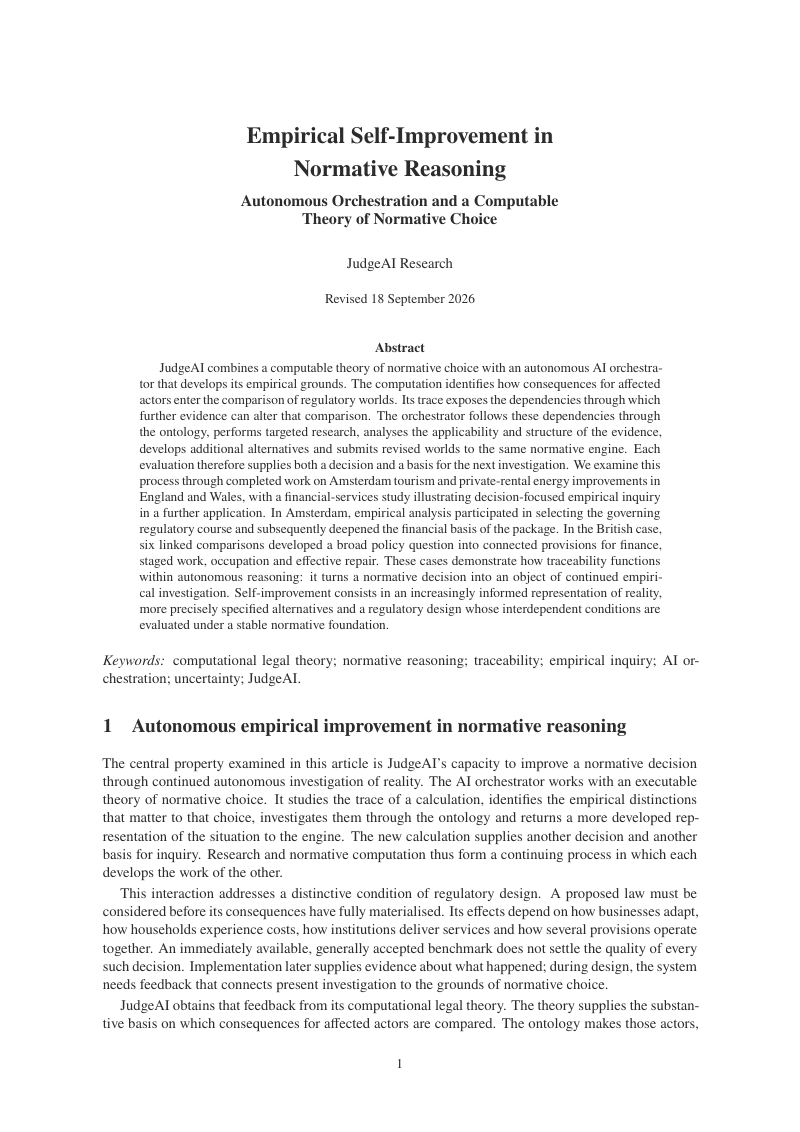
JudgeAI is a normative decision-making system that represents legally significant states and relationships in a computable ontology. It compares possible worlds created by different actions or inaction, models how consequences propagate, and produces outputs such as draft bills, draft judicial decisions, or instructions to AI agents. Its grounds can guide further research and recalculation.
›What are the pros and cons of JudgeAI?
Strengths
Makes legal and normative reasoning computable through an explicit ontology
Compares actions and inaction rather than evaluating only a single proposed outcome
Produces traceable grounds that support further research and model refinement
Supports multiple jurisdictions and several decision-output formats
Trade-offs
The system forms decisions without human involvement, which may not suit workflows requiring human adjudication
Its representation compresses reality into a finite ontology, creating an abstraction layer between real-world situations and computation
The product is described as ongoing research, so its long-term capabilities and operational maturity may continue to change
›What are JudgeAI’s key features?
Converts legally significant states and relationships into a bounded, computable ontology
Projects alternative actions and inaction into different possible worlds
Compares consequences across mutually exclusive courses of action
Produces traceable grounds for regulatory decisions
Supports jurisdiction selection across the United Arab Emirates, Ireland, the United Kingdom, the Netherlands, the United States, and China
Can produce draft bills, draft judicial decisions, or instructions to AI agents
›What are the best use cases for JudgeAI?
Compare alternative regulatory actions by modeling how their consequences propagate between participants
Develop draft bills from a modeled normative decision
Generate a draft judicial decision from facts, relationships, rules, and consequences
Provide an AI agent with an instruction derived from a computable normative framework
Refine a causal model and recalculate a decision as further research changes the model
›What is the pricing for JudgeAI?
Contact Sales
›Who is JudgeAI best for?
legal teamsUseful for teams exploring computable legal reasoning, alternative outcomes, and traceable grounds for draft decisions.
public-sector teamsPublic-sector groups can use its ontology and consequence modeling to examine regulatory actions and produce draft bills.
AI governance professionalsA fit for governance work that needs normative logic behind instructions issued to AI agents.
enterpriseEnterprise adoption may suit organizations testing shared normative infrastructure, but the autonomous decision process and ongoing research status require careful review.
Not for
- Teams that require a human judge or reviewer to make every final decision should avoid an autonomous decision-forming system.
- Buyers seeking a conventional legal research, contract review, or document management product should consider a tool built specifically for those tasks instead.
- Organizations that need a mature, fixed product with clearly published commercial terms may not be ready for a system described as ongoing research.
›What are the best JudgeAI alternatives?
 Lex MachinaChoose this instead if the primary need is legal analytics rather than normative decision modeling.→
 HarveyChoose this instead if the priority is legal research, answers, and workflow task support.→
 PolicyProof DeskChoose this instead if the main requirement is collecting vendor evidence, policy attestations, approvals, and audit records.→
 Jury Simulator→