

Forward Future Tools Library

OWL
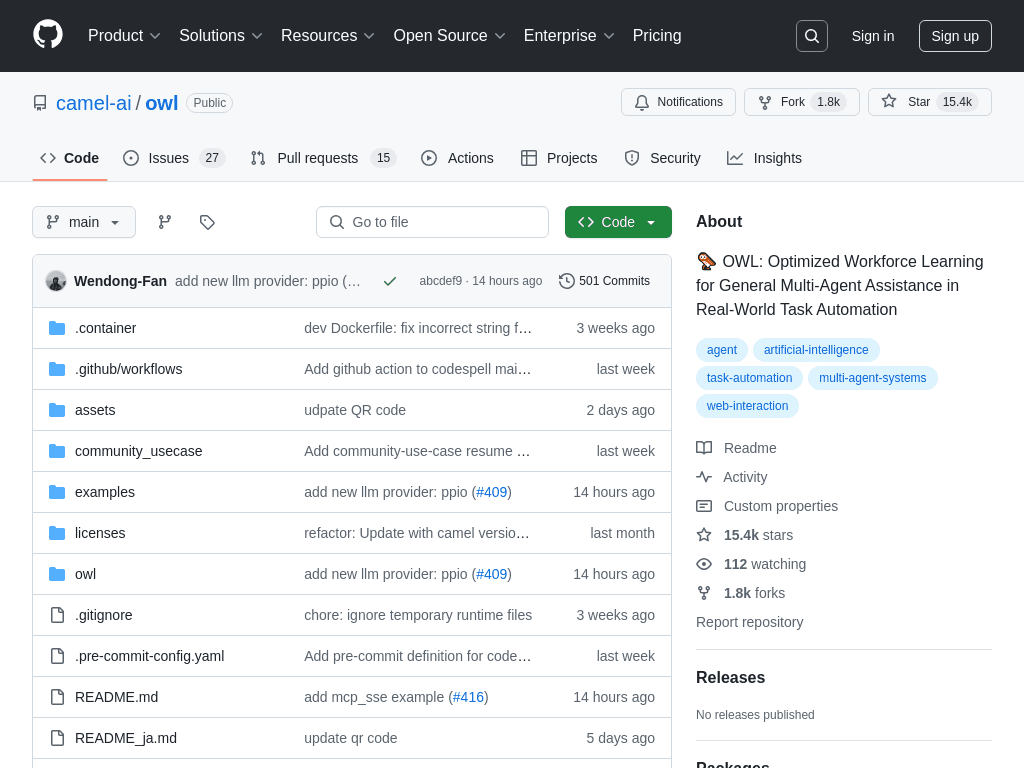
OWL is an open-source framework for developers and small teams building multi-agent systems that automate real-world tasks.
Try OWL →
github.com·Free
›What is OWL?
OWL, or Optimized Workforce Learning, is a multi-agent assistance framework built on CAMEL-AI. It coordinates dynamic interactions between agents for real-world task automation and can be installed through uv, Python virtual environments, conda, or Docker.
›What are the pros and cons of OWL?
Strengths
Public GitHub repository with contribution support
Designed specifically for multi-agent collaboration and task automation
Offers several setup paths, including uv, venv and pip, conda, and Docker
Built on the CAMEL-AI Framework
Trade-offs
Requires users to install and configure the framework through a Python environment or Docker rather than using a hosted application
Its architecture depends on the CAMEL-AI Framework
›What are OWL’s key features?
Multi-agent collaboration for real-world task automation
Dynamic interactions between collaborating agents
Installation through uv, venv and pip, conda, or Docker
›What are the best use cases for OWL?
Automating real-world tasks through multiple collaborating agents
Building multi-agent assistance workflows on top of the CAMEL-AI framework
›What is the pricing for OWL?
Free
›Who is OWL best for?
developersA fit for developers who want to build and run multi-agent task automation systems from an open-source framework.
small teamSmall teams with Python or Docker experience can use OWL to prototype collaborative agent workflows.
Not for
- Buyers wanting a hosted, no-setup automation service should skip OWL because it requires installation and environment configuration.
›What are the best OWL alternatives?
 OpenManusChoose this instead if you want an open-source framework focused on general AI agents.→
 AG2Choose this instead if you need a platform oriented toward production-ready AI agents.→
 CrewAIChoose this instead if you want a multi-agent platform positioned for workflows across multiple industries.→
 LangChainChoose this instead if you are building composable applications around large language models.→