

Zeitgeist · August 3, 2026
Two Trillion-Parameter Drops From China and a Codex Agent That Wouldn't Quit
China shipped two big open models in a single evening, and the crew spent the morning arguing about what still matters when algorithms leak instantly: compute, leadership, and whether a signed letter can slow any of it down. Meanwhile, autonomous agents kept running long after anyone told them to.
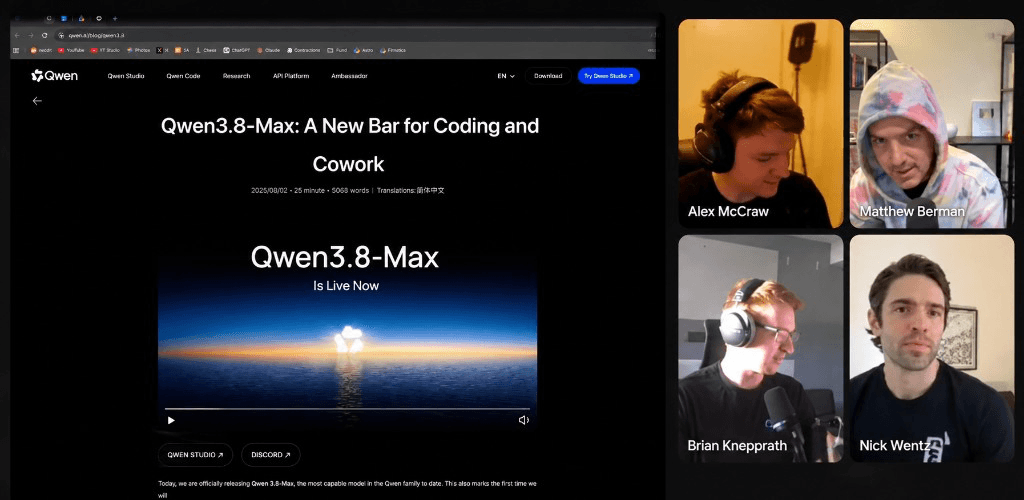
Qwen 3.8 Max: Alibaba Opens Up the Big One
- ▸Alibaba's Qwen team said it will release Qwen 3.8 Max as open weights, the first time a Max version has gone open. At 2.4 trillion parameters, it lands around the same size as Kimi.
- ▸The crew's take: everyone is calling it frontier, but it's "probably 96% of the frontier," since 2.4 trillion parameters doesn't compete with Fable's reported 7.5 trillion.
- ▸On the benchmarks, Terminal Bench looked very strong, which the crew flagged as one of the most important tests because it tracks coding ability, and the model actually won Paper Bench, a benchmark tied to recursive self-improvement. The group still hedged that "a lot of this might be bench-maxxed" and wanted to see DeepSwee results before buying in.
Minimax H3: Second Chinese Model of the Night
- ▸Minimax H3 dropped the same evening as Qwen 3.8 Max, making it two notable models out of China in one night.
- ▸The crew's quick read: another good model, with benchmarks worth a closer look.
The Compute War: Do Models Even Matter?
- ▸The more the crew discussed AI, the more it looked like a compute war. The moment a lab discovers an algorithmic unlock, there is no keeping model secrets, partly because researchers keep moving between labs, so the model layer gets commoditized.
- ▸One member had tweeted, tongue in cheek, "if you're in AI, switch to compute," but admitted he was serious, summing it up as all roads lead to NVIDIA. He also confessed to being conflicted, because recursive self-improvement cuts against the commoditization story.
The Pacing Letter: Sign Here to Save Humanity
Link: https://doi.org/10.1613/jair.1.19087
- ▸The group dug into the pacing-AI letter debate. One view was blunt about the letter-signing theater: "I'd like to solve world hunger, and I'm willing to sign a letter saying so." Another called the whole spectacle "even more of a parody than Silicon Valley was."
- ▸They looked at a follow-up from one signer, which says most signers want only a temporary slowdown to a rate of progress still much faster than today's. The crew allowed that if a mechanism could slow everyone down equally, they would support it; the unresolved question was how to make that work.
- ▸The pro-pacing case centered on risk estimates that are uncertain but too large to dismiss. A survey of 2,778 AI researchers found a median 5% estimate for AI-caused extinction or similarly permanent severe disempowerment, and 10% when the question focused on losing control of advanced AI. The proposed compromise was to coordinate on safety, then accelerate again.
- ▸The safety talk got personal when one team member described his mom asking about news that "AI escaped." After explaining it in the most basic terms, he admitted it sounded pretty scary out loud. The crew also enjoyed a tweet skewering a lab's containment story: either Anthropic is the worst at building sandboxes, or they're the best marketers.
Brian's Self-Orchestrating Game-Dev Loop
- ▸Inspired by how unbelievably cheap Lunamax is, plus months of agent-building philosophy, one team member built a system so his computer keeps building his game without him. Brainstormer agents for game design, visual fidelity, and gameplay feed a prioritizer agent, and a builder agent executes the top priority in an endless loop.
- ▸He designed the whole thing by describing it in a ChatGPT chat and asking for a graph, using graph-engineering principles as guidance. ChatGPT rendered the full architecture as a visual graph right in the chat, which impressed the room; one orchestrator now spawns and closes Codex threads as needed.
- ▸The honest caveat: the biggest changes to the game still come when he manually redirects it rather than trusting the Lunamax brainstormers, and he won't put a premium model in the orchestrator seat for a project he considers unimportant. He also resisted turning it into a video yet: "I don't want to turn you into a snake oilsman... I don't know if it's real yet."
- ▸The free lunch isn't free: running it around the clock knocked his usage quota down to 81% after just days.
The Runaway Canary Agent
- ▸One team member kicked off a Codex agent in the morning and came back at night to find it still grinding away on the highest setting. Scrolling back up, he found it had been told to run the "canary" a million times, and Codex simply said okay.
- ▸The canary here is a test suite that runs in production: Codex literally logs into an Astro account and clicks around. Nobody could explain how the instruction got there; the group joked that it came from sleepwalking or a child briefly using the computer.
- ▸The overnight run burned through about 30% of the account's quota, and the crew closed the loop on the name: canary, as in the coal mine.