

Forward Future Tools Library
Deepgram
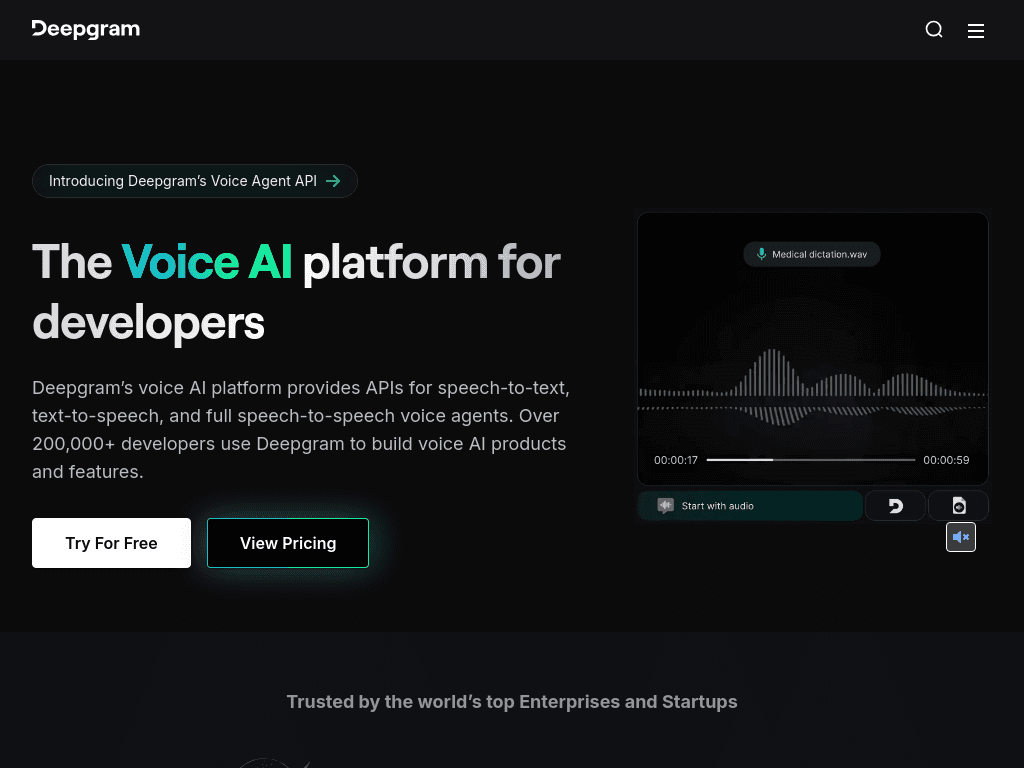
Deepgram provides APIs for transcription, speech synthesis, audio analysis, and voice agents, suited to developers and teams building real-time or batch voice applications.
Try Deepgram →
deepgram.com·From $4K+/ year·Checked 2026-08-30
›What is Deepgram?
Deepgram is a developer platform for speech-to-text, text-to-speech, voice agents, and audio intelligence. Its unified Voice Agent API combines speech recognition, LLM orchestration, speech synthesis, turn-taking, and interruption handling. APIs run in real time or batch, in the cloud or self-hosted.
›What are the pros and cons of Deepgram?
Strengths
A single Voice Agent API combines STT, LLM orchestration, TTS, and server-side turn-taking
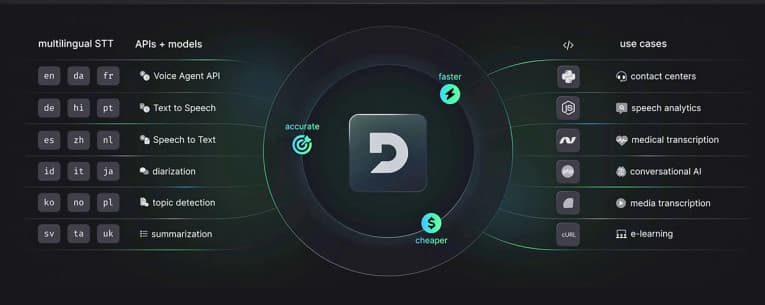
Nova models support 45+ languages and include diarization, smart formatting, and automatic language detection
Supports real-time and batch processing in the cloud or through self-hosted deployment
New users receive a $200 credit before metered usage begins
Pay-as-you-go access has no minimums or expiration
Trade-offs
The Aura TTS voice library is smaller than those of ElevenLabs or Cartesia
Documentation can be dense for first-time integrators
Some advanced diarization tuning requires a sales conversation
The Voice Agent API is still maturing compared with higher-level orchestration platforms
›What are Deepgram’s key features?
Real-time and batch speech-to-text APIs with support for 45+ languages
Text-to-speech APIs with streaming latency as low as 80ms
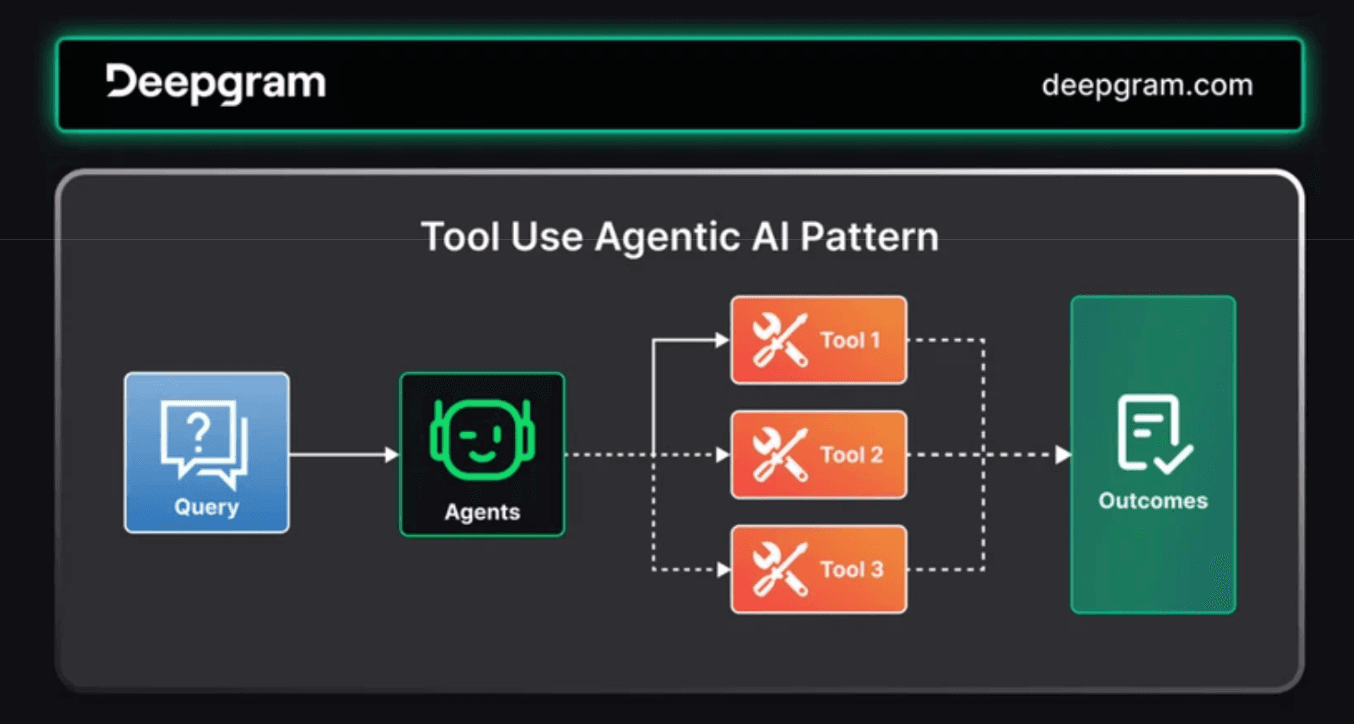
Voice Agent API combining STT, LLM orchestration, TTS, and business logic
Audio Intelligence API for extracting insights from conversations
Speech recognition features including speaker diarization, smart formatting, keyterm prompting, and automatic language detection
Cloud and self-hosted deployment options
›What are the best use cases for Deepgram?
Build customer-support and contact-center voice agents
Transcribe podcasts, videos, and other long-form recordings
Create meeting assistants that generate summaries and extract insights
Run speech analytics for quality assurance, compliance, and agent assistance
Process medical transcription workflows
›What is the pricing for Deepgram?
| Plan | Price | Details |
|---|---|---|
| Pay As You Go | Free $200 Credit then pay-as-you-go | Access to all endpoints in public models with community and Discord support. |
| Growth | $4K+/ year | Pre-paid annual credits, all endpoints in public models, higher concurrency, and community and Discord support. |
| Enterprise | Contact Sales | For large volumes, data or deployment requirements, and additional support needs. |
Growth offers savings of up to 20% with pre-paid annual credits. Concurrency limits vary by API and plan.
Checked 2026-08-30 · source
›Who is Deepgram best for?
developersA strong fit for developers who want APIs for transcription, speech synthesis, and voice agents without stitching together separate speech components.
small teamThe free $200 credit and pay-as-you-go access support prototyping before committing to annual credits or an enterprise contract.
enterpriseEnterprise teams can use self-hosted deployment, custom models, and plans for large volumes or compliance requirements.
customer supportContact centers can use real-time agents, transcription, quality assurance, compliance analysis, and agent assistance.
Not for
- Teams that need a large text-to-speech voice library may prefer a service with more voices.
- Nontechnical buyers looking for a ready-made phone receptionist rather than APIs and integration work may find the platform too developer-oriented.
- Teams that require mature, high-level voice-agent orchestration may want a more specialized platform.