

Forward Future Tools Library

Dify
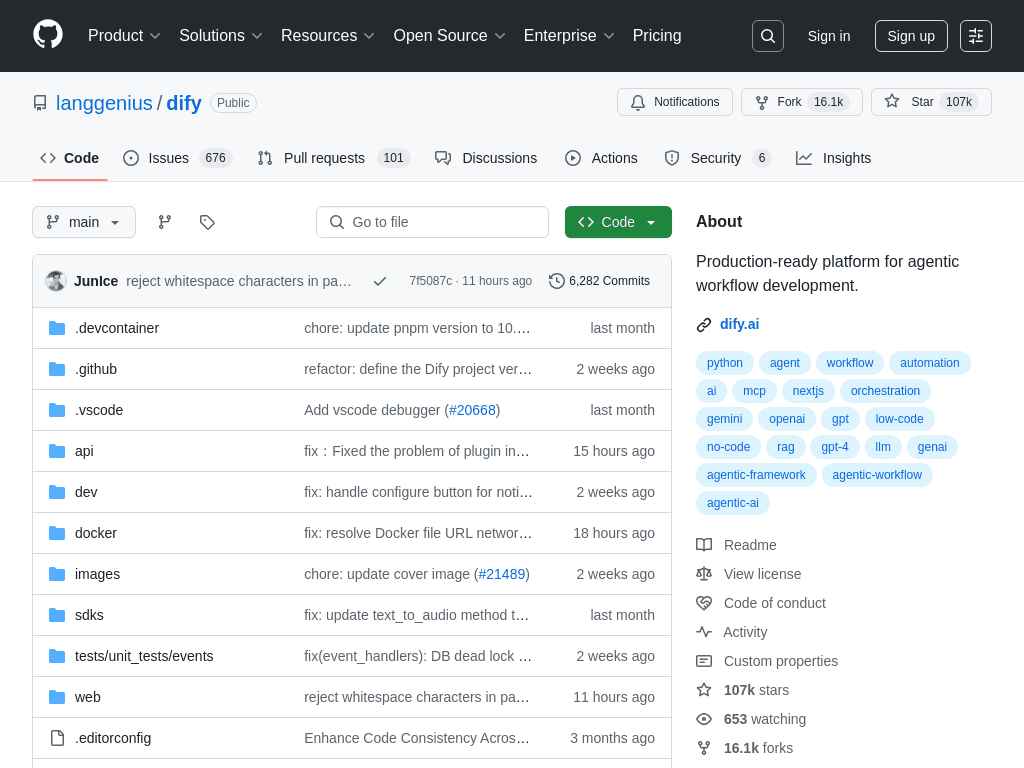
Dify combines visual AI workflows, RAG pipelines, agent tools, model connections, and observability for developers and teams that want to build and deploy LLM applications on cloud, VPC, or their own infrastructure.
Try Dify →
github.com·Free + paid plans·Checked 2026-08-15
›What is Dify?
Dify is an open-source LLM application development platform. It provides a visual workflow builder, RAG pipelines, agent capabilities, model management, and observability integrations. Applications can be deployed through Dify Cloud, VPC, or self-hosted Docker Compose installations.
›What are the pros and cons of Dify?
Strengths
Open-source deployment option for teams that want to run Dify themselves
Combines workflow building, RAG, agents, model management, and observability in one platform
Supports both hosted model providers and local model endpoints
Offers a visual workflow approach while retaining support for more technical configurations
Can move applications from prototype to production across cloud, VPC, or self-hosted deployments
Trade-offs
Self-hosting adds infrastructure and maintenance responsibilities
Dify connects to models but does not serve or run the models itself
Enterprise governance and compliance are not fully mature out of the box
Documentation can lag behind product features
The platform's abstraction layer may limit developers who want complete code-level control
›What are Dify’s key features?
Visual builder for agentic workflows
RAG pipelines for adding documents and retrieved context to applications
Agent capabilities for deciding which tools to call
Connections to hosted providers such as Anthropic, OpenAI, Gemini, and DeepSeek
Support for local or OpenAI-compatible endpoints including Ollama, LM Studio, and vLLM
Observability integrations including Opik, Langfuse, and Arize Phoenix
Deployment through cloud, VPC, or self-hosted environments
›What are the best use cases for Dify?
Prototyping and deploying LLM applications
Building document-grounded RAG assistants
Creating agent workflows that call external tools
Developing internal AI tools on self-hosted infrastructure
Managing model connections and debugging application behavior
›What is the pricing for Dify?
| Plan | Price | Details |
|---|---|---|
| Self-hosted | Free | Run the open-source platform on your own infrastructure, with separate infrastructure and model API costs. |
| Sandbox | Free | Free managed cloud plan for trying Dify Cloud. |
| Professional | about $59/mo | Managed cloud plan for teams that need more than the free Sandbox. |
| Team | around $159/mo | Managed cloud plan for larger team usage. |
| Enterprise | custom | Enterprise cloud offering with custom pricing. |
Self-hosting still requires infrastructure and separate LLM inference costs. Cloud prices are reported for 2026 and may change.
Checked 2026-08-15 · source
›Who is Dify best for?
developersA strong fit for developers building RAG applications, AI agents, or internal LLM tools with visual workflows.
small teamSmall technical teams can use one workspace to prototype workflows and deploy them without assembling a separate LLM application stack.
soloSolo builders who are comfortable with Docker and infrastructure can use the self-hosted edition to control deployment and model connections.
enterpriseEnterprise teams with deployment and model-management needs may find the cloud, VPC, and self-hosting options useful, but should assess governance requirements carefully.
Not for
- Nontechnical buyers seeking a fully managed, no-maintenance no-code AI builder should skip it because self-hosting requires infrastructure upkeep.
- Teams requiring mature enterprise compliance and governance out of the box should look for a more established governance layer.
- Developers who prefer complete code-level control may find Dify's abstraction layer restrictive.