

Forward Future Tools Library

LandingLens
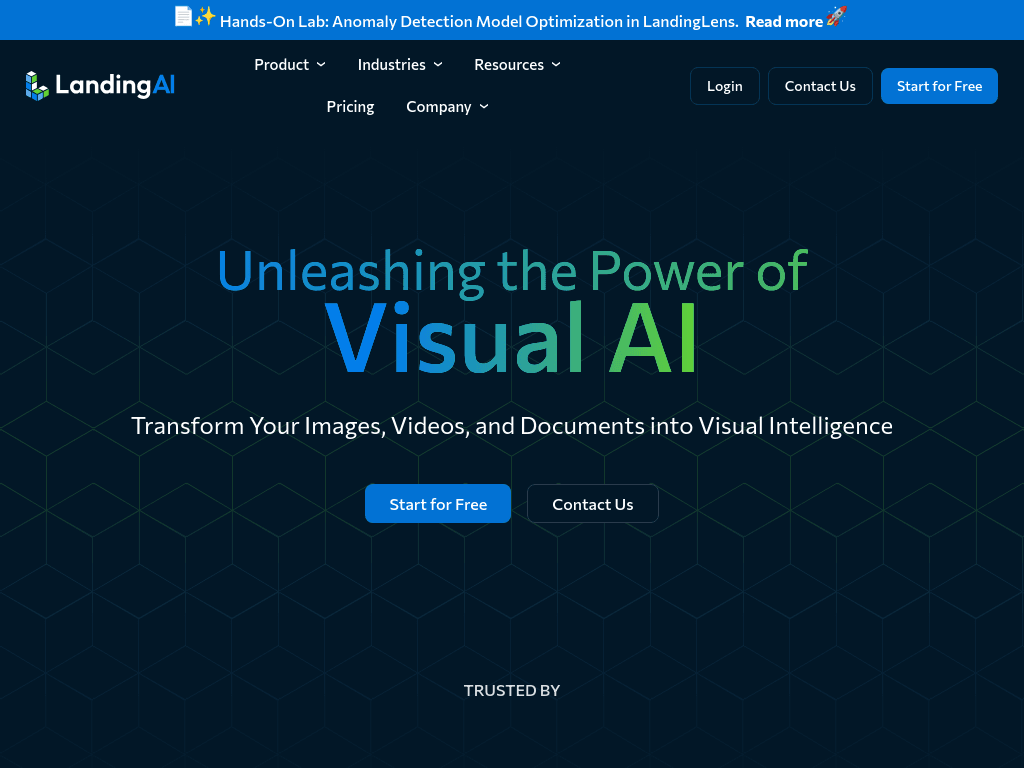
LandingLens helps manufacturing, retail, and other operations teams build computer vision models for defect detection, product inspection, and visual classification.
Try LandingLens →
landing.ai
›What is LandingLens?
LandingLens is a computer vision platform that supports data labeling, model development, and deployment for visual inspection tasks. It helps domain experts create training data without machine learning expertise and can export models to NVIDIA Jetson devices and industrial PCs. Reported applications include defect classification, shelf share analysis, and battery inspection.
›What are the pros and cons of LandingLens?
Strengths
Guided labeling lets domain experts create training data without machine learning expertise
Supports deployment to NVIDIA Jetson devices and industrial PCs
Provides REST API integration for operational workflows
Covers industrial, retail, automotive, food and beverage, and medical device applications
Trade-offs
Deployment requirements vary by facility
Pricing information is not consistent across Landing AI offerings, with a third-party LandingLens listing starting at $2,500 per month
The platform is oriented toward specialized visual inspection and classification use cases
›What are LandingLens’s key features?
Guided labeling workflows for creating computer vision training data
Automated defect classification for industrial quality control
Model export to NVIDIA Jetson and industrial PCs
REST API integration for connecting computer vision models to existing workflows
LandingLens deployment on Snowflake
Domain-specific large vision models for specialized inspection tasks
›What are the best use cases for LandingLens?
Classifying manufacturing defects during quality control
Calculating retail shelf share from store imagery
Inspecting electric vehicle batteries with advanced imaging
Detecting defects in medical devices and electronics
Checking food and beverage product quality
›Who is LandingLens best for?
quality control engineersA strong fit for teams automating defect classification in manufacturing and electronics.
retail operations teamsUseful for analyzing shelf share from visual data.
automotive industry professionalsSuited to battery inspection and other image-based checks in automotive production.
developersWorth considering when REST API access and edge deployment are requirements.
Not for
- Teams seeking a general-purpose productivity tool rather than computer vision for inspection, classification, or shelf analysis
- Organizations that cannot support site-specific deployment planning and infrastructure decisions
›What are the best LandingLens alternatives?
 Basic.aiChoose this instead if the main requirement is preparing and annotating computer vision data.→
 ClarifaiChoose this instead if you need a broader platform covering visual recognition and data management.→
 Weights & BiasesChoose this instead if the priority is managing the broader machine learning model lifecycle.→
 Wegic AI→