

Forward Future Tools Library
Skyulf
Skyulf combines visual or Python ML pipelines, dataset exploration, background training, experiment comparison, deployment, and monitoring for teams that need to keep data on their own infrastructure.
Try Skyulf →
skyulf.com

›What is Skyulf?
Skyulf is a self-hosted MLOps workspace and an Apache-2.0 Python library for building reproducible scikit-learn pipelines. The workspace ingests and profiles datasets, supports visual or code-based feature engineering, runs training jobs, compares experiments, registers models, and serves deployments through a REST API. Pipelines can also be exported to runnable Jupyter notebooks.
›What are the pros and cons of Skyulf?
Strengths
Keeps datasets and model workflows on a user's own machine or server
Combines visual pipelines and Python code while producing versionable pipeline artifacts
Tracks dataset versions and fingerprints data, steps, and models for repeatable experiments
Provides an integrated path from data ingestion and exploration to deployment and monitoring
Offers an Apache-2.0 core library that can be used inside another product
Trade-offs
The full workspace must be run on the user's own machine or server, including its application infrastructure
The full application uses AGPLv3, while skyulf-core uses Apache-2.0, so licensing requirements differ by component
The documented Python engine is centered on scikit-learn pipelines, rather than presenting a broad multi-framework training stack
›What are Skyulf’s key features?
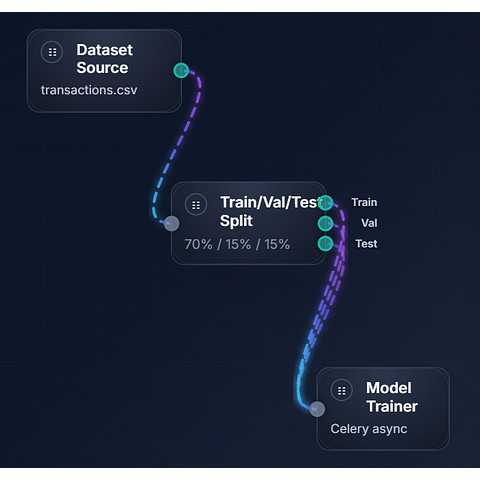
Visual canvas with 35 node types for data cleaning and feature engineering
Python pipeline API built on scikit-learn that accepts pandas or Polars frames
Dataset ingestion from CSV, Excel, JSON, Parquet, and S3-compatible storage
Automated profiling with distributions, correlations, outlier detection, PCA views, surrogate decision trees, and causal discovery
Background training runs with experiment comparison and metric tracking
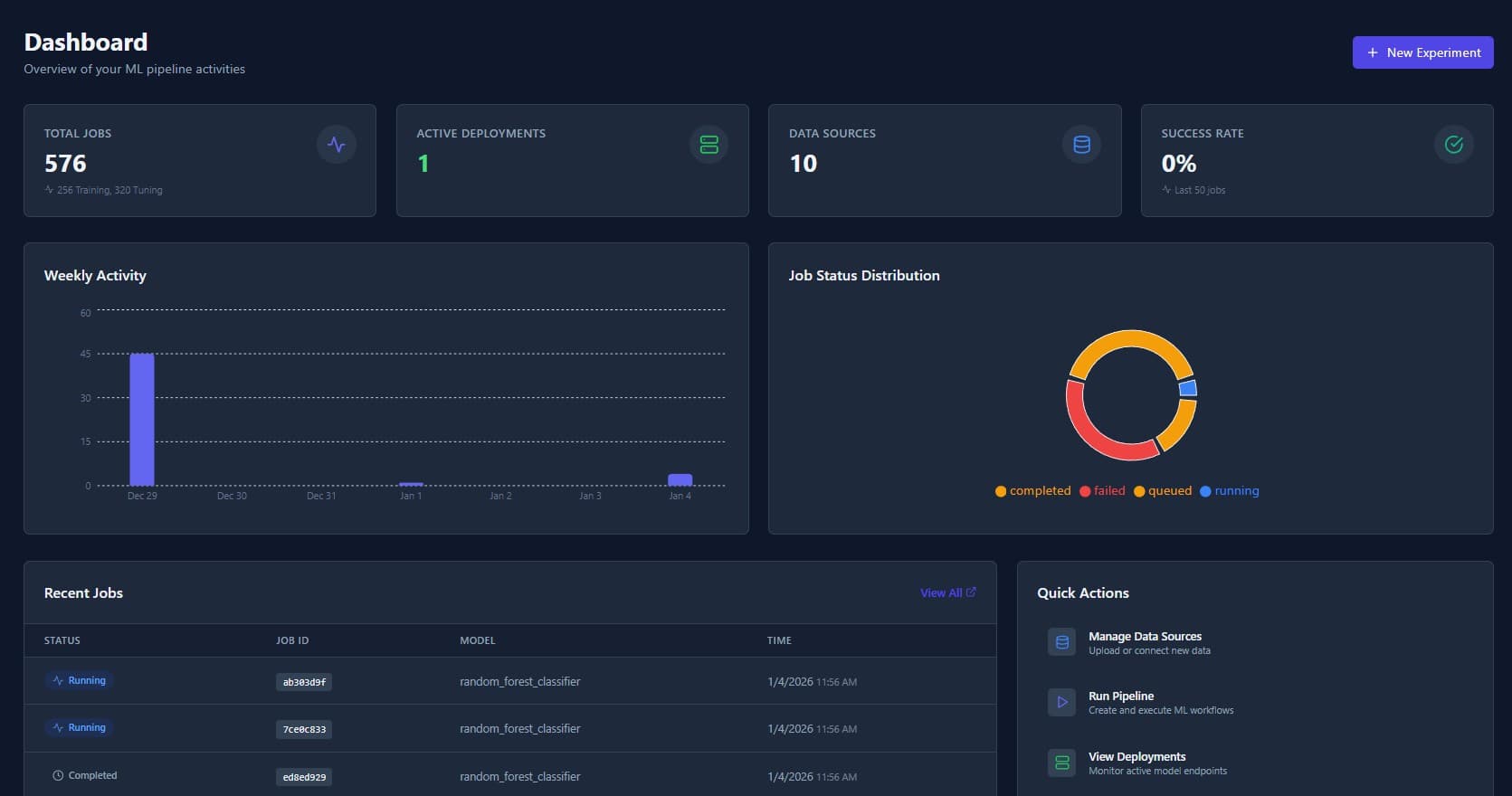
Model registry, deployment, monitoring, and an API testing panel
Pipeline exports to runnable Jupyter notebooks
›What are the best use cases for Skyulf?
Build reproducible tabular ML pipelines from raw files through model training
Explore column quality, relationships, outliers, and target drivers before modeling
Run feature engineering and training experiments while continuing work in the workspace
Deploy a selected model to a self-hosted REST API and test JSON predictions with latency results
Use the standalone library in notebooks or scripts when a full server and UI are unnecessary
›Who is Skyulf best for?
developersUseful for developers who want to build, version, and run ML pipelines through Python or a visual canvas.
data scientistsData scientists can use the automated EDA, experiment comparison, notebook export, and model deployment workflow.
ML engineersML engineers get a self-hosted path from feature engineering and training to a testable inference API.
enterpriseOrganizations handling sensitive or regulated data can keep datasets and model operations inside their own infrastructure.
Not for
- Teams looking for a managed cloud MLOps service instead of operating the workspace on their own machine or server
- Organizations that cannot adopt AGPLv3 for the full application
- Users who need a workflow centered on frameworks other than the documented scikit-learn engine
›What are the best Skyulf alternatives?
 AIxBlockChoose this instead if decentralized AI infrastructure and access to decentralized resources are central requirements.→
 ClarifaiChoose this instead if the main requirement is visual recognition, NLP, and data management rather than a self-hosted scikit-learn pipeline workspace.→
 Owl Browser→
 LongCat Flash→