

Forward Future Tools Library

UI-TARS-7B-SFT
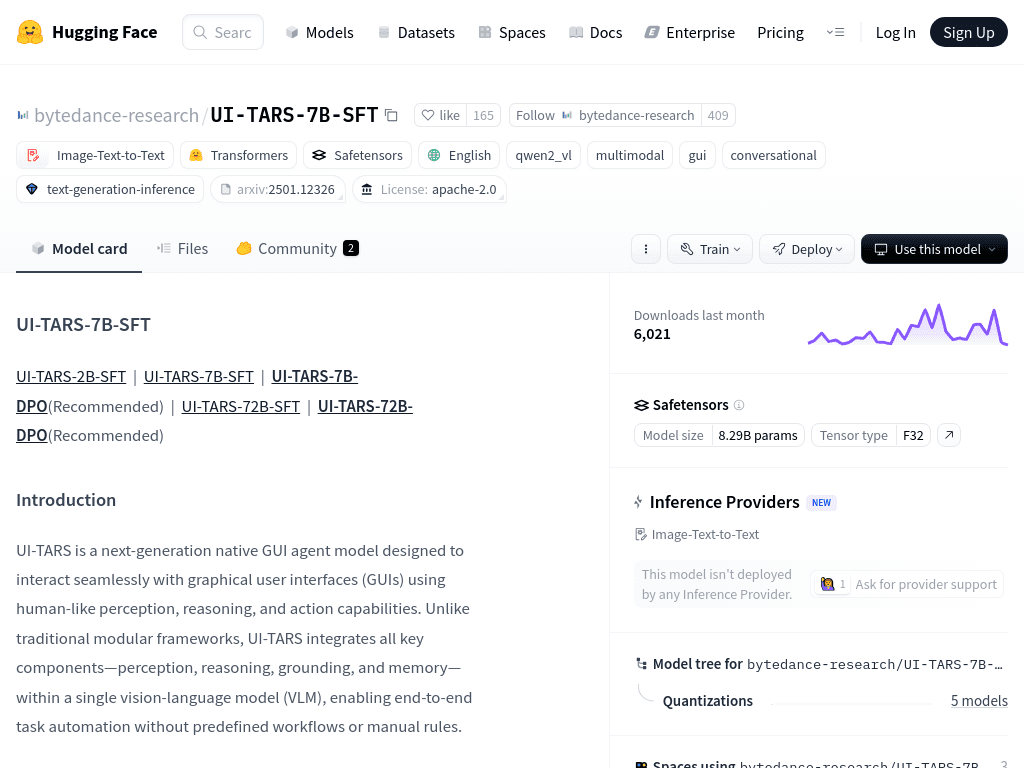
UI-TARS-7B-SFT is an open-weight multimodal model for developers building or evaluating GUI agents that interpret screenshots and produce interface-oriented actions.
Try UI-TARS-7B-SFT →
huggingface.co·Free
![huggingchat/chat-ui · [NEW] Assistants](/_next/image?url=https%3A%2F%2Fmch9boduqwxvwzvs.public.blob.vercel-storage.com%2Ftools%2Fenrichment-images%2Fui-tars-7b-sft-300103debb8a.png&w=3840&q=75)
›What is UI-TARS-7B-SFT?
UI-TARS-7B-SFT is a vision-language model for graphical user interface interaction. It combines perception, reasoning, grounding, and memory in one model rather than separate modules. The checkpoint accepts text and images and can be run with Transformers, vLLM, SGLang, or Docker.
›What are the pros and cons of UI-TARS-7B-SFT?
Strengths
Open weights and an Apache-2.0 license support local use and product integration
A single model handles perception, reasoning, grounding, and memory
The 7B checkpoint reports strong perception results, including 79.7 on VisualWebBench and 93.6 on WebSRC
Supports several local deployment paths, including Transformers, vLLM, SGLang, and Docker
Trade-offs
The 7B model size limits complex reasoning and instruction following compared with larger models
The model requires a local serving setup and suitable compute for deployment
Tool use and function calling are not specified in the available capability descriptions
Long-form generation is restricted by a reported 2,048-token maximum output for the similarly named API model
›What are UI-TARS-7B-SFT’s key features?
Processes text and image inputs through a multimodal language model
Combines perception, reasoning, grounding, and memory in one model
Supports GUI perception and grounding evaluation
Runs locally with Transformers
Can be served through OpenAI-compatible endpoints using vLLM or SGLang
Available under the Apache-2.0 license
›What are the best use cases for UI-TARS-7B-SFT?
Evaluate how models identify text, icons, and controls in interface screenshots
Prototype agents that interpret web, desktop, mobile, or game interfaces
Run image-grounded interface analysis locally rather than sending inputs to a hosted API
Serve multimodal inference behind an OpenAI-compatible endpoint
Benchmark GUI perception and grounding against other vision-language models
›What is the pricing for UI-TARS-7B-SFT?
Free
›Who is UI-TARS-7B-SFT best for?
developersA fit for developers who need open-weight GUI perception or want to integrate a multimodal model into their own agent stack.
AI researchersUseful for benchmarking interface perception, grounding, and screenshot-based task understanding.
small teamSmall teams with GPU access can use the model to prototype local GUI-agent workflows without relying on a closed model.
Not for
- Teams that need a managed GUI automation product with documented tool execution and production support
- Buyers who want a hosted subscription or turnkey workflow builder instead of deploying model infrastructure
- Users handling complex, multi-step tasks who cannot validate outputs from a 7B model
›What are the best UI-TARS-7B-SFT alternatives?
 OpenManusChoose this instead if you need a broader open-source framework for building general AI agents rather than a dedicated GUI vision-language checkpoint.→
 LangChainChoose this instead if you need composable application components for connecting language models to tools and workflows.→
 Box AI→
 CrewAI→